Wireless Watch: Wi-Fi takes its place at the heart of carriers’ data strategies, looking beyond offload
Nov 16, 2011 – Rethink Research
The enthusiasm with which mobile operators have embraced data offload to Wi-Fi, as a way to ease the strain on their creaking 3G networks, often obscures the fact that what they are doing remains, for now, highly unsophisticated. Some cellcos have invested large sums in building their own hotspot networks, or connecting to those of partners, but beyond the clear benefit of getting traffic off the cellular system, they are not getting much return. The user experience remains clumsy, without seamless hand-off between 3G and WLan nodes; the hotspots are not usually scientifically planned to mirror the areas of most traffic; operators cannot track user behaviour once the customer has been offloaded, and so lose the chance to monetize; and the link to the unlicensed network may not even be fully secure.
All these weaknesses indicate the haste with which panicking cellcos rushed to adopt offload strategies, but also the fact that most of them initially regarded Wi-Fi as a short to medium term stopgap, before the happy days when their data burdens would be lifted by the combination of LTE and HSPA+ upgrades, and offload to the far more controllable femtocells. Now, however, as operators start to roll out the air interface upgrades and the femtos, they are quickly realizing that, while both those strategies will be very helpful in meeting exploding mobile data demands, they will not be enough in themselves. Introducing LTE will, on average, quadruple data capacity, says Cisco, but most cellcos in developed economies will see their capacity requirement go up by 32 times by 2015.
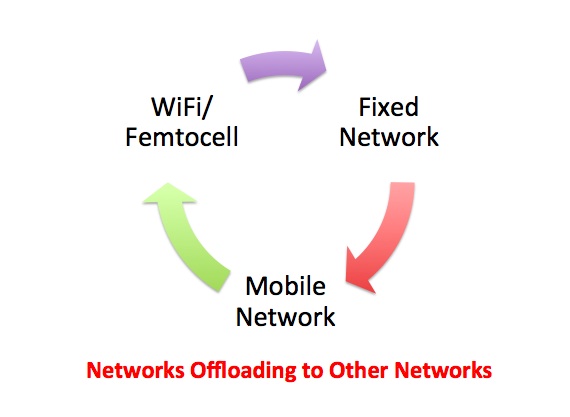
Against such a backdrop, it is clear that carriers will have to harness any piece of technology and spectrum they can grasp, and that will mean keeping Wi-Fi permanently in the mix. And if the platform is to be a long term fixture, it will need to be approached more strategically, and with greater thought for how to maximize its benefits both to customers and the carrier itself. Operators are starting to think beyond simple offload, and think in terms of bringing Wi-Fi access points into the future ‘HetNet’ (heterogeneous network), which will boost capacity and coverage by integrating multiple air interfaces, cell sizes and spectrum bands. In a new survey of over 100 mobile operators, Rethink Technology Research studied the ways in which carriers will plan their future access networks in order to meet the needs of the data boom. The respondents identified five key weapons, most of them complementary – in the near term, Wi-Fi offload, small self-organizing cells, and more sophisticated traffic management tools; and a few years out, the extension of those trends into HetNets and LTE-Advanced upgrades.
For deployments in 2011-2013, over half of carriers rate offload as one of their top two weapons against the data deluge, followed closely by the move towards smaller, self-organizing cells, and 46% are also heavily focused on traffic management. Only 4% see LTE-Advanced as a top priority in this timeframe, but for 2014-2015, the standards upgrade leaps becomes a key strategic factor for 30% of respondents. LTE-A supports HetNets in a more standardized way and should spur their adoption, and indeed, for the second wave, over one-quarter of cellcos see HetNets as one of their top two weapons, while simple offload has dropped back to 20%.
The findings show that carriers will move from their unsophisticated use of Wi-Fi towards a more complex and carefully planned strategy which relies on WLans, indoor femtocells and public access metrocells to supplement or even replace the traditional cellular network.
But for carrier Wi-Fi to take this enhanced role, the holes currently existing in the platform need to be filled rapidly, a process which will throw up some key opportunities for companies with expertise in critical areas - metrozones, cross-platform billing and hand-off, security, interference management, and traffic prioritization. Obvious giants are already staking their claim, from Cisco to Nokia Siemens, but some of the more interesting moves are seen coming from the smaller players as the worlds of Wi-Fi offload, small cells and intelligent traffic management collide, and as operators start to demand that their WLans are intelligent, secure and fully integrated with their 3G and 4G systems.
Among these independents are two stalwarts of the Wi-Fi market, Ruckus Wireless and BelAir Networks, which are now looking to expand their remit deep into the heart of the cellcos’ networks and carve out a position there ahead of the expected HetNet boom. Ruckus has its roots in the indoor market, particularly video-over-WLan systems, and learned how to deal with carriers in that space.
Last year it ventured outdoors with metrozone products and scored its flagship offload contract with Japan’s KDDI Wireless, which recently announced “the world’s first and largest ‘instant-on’ Wi-Fi access and mobile data offload service”. It is using Ruckus access points and controllers to build a hotspot network which will reach 100,000 locations by next March, supporting seamless hand-off from 3G and free Wi-Fi for data customers. As the GigaOM blog pointed out, “100,000 access points will give KDDI a Wi-Fi node for every 320 customers. AT&T has a Wi-Fi access node for every 4063 customers. The sheer density of KDDI’s deployment assures that Wi-Fi will become a major component of its mobile data networking strategy, rather than a mere supplementary technology.”
Meanwhile, BelAir has major offload deals with AT&T and several US cablecos, including Cablevision, the poster child for using Wi-Fi instead of cellular MVNO deals to add a wireless element to a cable triple play. Cable operators are a key target market for the carrier Wi-Fi brigade, since they have no vested interest in 3G solutions (even the most 3G-oriented of the US players, Cox Communications, pulled out of offering mobile services this month because of the costs and poor returns).
But BelAir is looking well beyond simple offload, and indeed, no longer likes to be known as a Wi-Fi firm, because it is supporting LTE too in its latest small cell platform, the 2100, designed to be a component of a flexibly planned HetNet. Drawing on a decade in the Wi-Fi metro space, it is now focusing on metrozones in their newer incarnation – carrier-controlled, running a mixture of Wi-Fi and cellular small cells, and hugely scalable. A couple of months after unveiling the 2100, which has integrated backhaul as well as multimode support, the vendor is moving further into the heart of the carrier network with its GigXone offering. This consists of a set of Wi-Fi controllers and access points, which can scale metro networks to hundreds of thousands of nodes.
CMO Ronny Haraldsvik says a commercial deployment of 100,000 nodes is “not very far away”, and in future such zones will take Wi-Fi from a “stopgap solution” to a permanent part of the network strategy, he argues. This will be driven by the emergence of products which make Wi-Fi truly carrier class – a category where he currently places only BelAir, Cisco and Ruckus – and also by standards work, particularly around HetNets in LTE+, integration of APs with femtocells, and in the Hotspot 2.0 initiative. The latter will use the upcoming 802.11u standard extension, for roaming with 3G, and there will be a Wi-Fi Alliance certification program from 2012, for a set of seamless roaming and authentication standards.
Not only does BelAir hope to be part of carriers’ offload and HetNet strategies with beefed-up capacity and multimode support, but it believes it is time for operators to think more closely about monetizing their Wi-Fi connections and think of new business models. The GigXone not only enables more than enough capacity to support mobile data needs, but it supports virtualized access points, so that cellcos can sell the excess to third parties.
Several cellcos round the world are enhancing their brand awareness and business model by offering Wi-Fi access services outside their own customer bases – even, in the case of O2 UK, for free. GigXone not only works with existing 3GPP billing systems, but via virtualization, can enable up to eight virtual Lans, which can offer hosted services to the third party partners or to private customers such as enterprises. Virtual small cells enable each SSID to be independently configured to connect to different carrier core networks. Security, mobility, AAA and DHCP parameters can also be set on a per-SSID basis.
“Building a small cell network once and leveraging it many more times is nirvana for carriers and their investors in these capex strained times,” said Haraldsvik, and BelAir CEO Bernard Herscovich added in a statement: “Small cells are not just about 3G offload anymore as our carrier customers want to offer a reliable brand experience throughout their network service areas, regardless of radio access technologies. Mobile and cable carrier customers asked us to build a highly scalable system well suited for indoor and outdoor, business and consumers, with multimode small cell options for licensed and unlicensed, and that’s what we did with GigXone.”
The products contained within GigXone include the multimode small cells themselves as well as Carrier Cloud and HotZone controllers. There are five new elements. The Carrier Cloud Controller (BelAirCC8000) can support 500 access points and, with the BelView software, can scale to 100,000 cells with the controller managing wide area mobility via Mobile IP, L2VPN or GRE tunnels. The HotZone Controller (BelAirHZ4000) is a smaller, premises based system for ad hoc deployments such as convention centers, or for enterprises and smaller zones. The cells themselves are the BelAir 1000, the entry level model for indoor locations; the BelAir 1100 for campus networks or events; and the BelAir3200, a strand‐mounted product for cablecos with integrated DOCSIS 3.0 cable modem.
Cisco is also addressing the walls that still exist between the cellco’s 3G and Wi-Fi networks. Earlier this year, it introduced the Next Generation Hotspot system for its Aironet 1550 access points, a platform for authentication and roaming. "We are positioning this as a peaceful coexistence with 4G. Both have a role," said Jaishree Subramania, product marketing manager for mobility. “The very foundation of our approach is a carrier grade system across the entire network architecture. The key is the unification for architecture. It's all about delivering consistent Wi-Fi experience across a variety of environments, and all of this can be managed and controlled from a single point in a carrier network." The architecture will also support 802.11u, which allows Wi-Fi APs to advertise themselves and devices to connect to them using SIM-based authentication, without the user having to select an SSID number. Cisco is also thinking in terms of enabling new revenue streams for operators, saying 11u will “pave the way for new service delivery”, such as retailers offering instant coupons to people coming into their stores. Such applications would harness not just 11u but the Mobility Services Advertisement Protocol (MSAP), which allows 11u devices to obtain local information as they authenticate. "802.11u might be able to advertise that there are services available, while MSAP is the protocol that get the service into an app to be delivered down to a device," Cisco said.
Improved roaming, hand-off, authentication and services could all make Wi-Fi a more strategic part of the cellco’s network, but all that could come to grief if the connections are not fully secure. This has been a neglected risk, according to network infrastructure vendor Radisys, which took a position in the offload and data management markets when it acquired Continuous Computing. It promises to secure the ‘offload link’ between the 3G system and the WLan, using standards-based technology rather than expensive proprietary solutions.
Currently, the firm says, carriers are often leaving that link in their data chain poorly secured, or they are spending large sums on customized solutions. The upgraded SEG-100 security gateway, by contrast, supports standards like I-WLan (Interworking Wireless Lan), and the 3GPP specification, TTG (Tunnel Terminating Gateway).
Without a dedicated offload solution from such as a TTG platform, the connection between the carrier’s network and the WLan is often “untrusted” and insecure, warns Radisys. “Carriers are looking for highly scalable and cost effective solutions to protect networks and mobile traffic,” said senior product line manager Jeff Sharpe. “Compared to enterprise class security offerings, the SEG-100 is a carrier class solution that supports an industry-best 200,000 concurrent, bidirectional IPSec tunnels running at speeds greater than 10Gbps on a stateful, high availability system, thus enabling lowest cost per subscriber.”
Manish Singh, CTO at Radisys, told TotalTelecom that backhaul was another potential security risk, which the SEG-100 could help address. Moving traffic to third party backhaul systems was “creating a security hole, and you need to plug it,” he said. "If the weakest link is the backhaul then the hackers will target that.” The issues arise when cellcos address the strain on their backhaul links by leasing additional capacity from third parties, or by offloading. Any transfer between different networks, especially those out of the carrier’s control, can open up vulnerabilities.
The company claims that the SEG-100 is the only turnkey TTG and I-WLan solution which can be integrated automatically into any chassis or network supporting the ATCA standard. This is because it comes as an ATCA blade rather than a standalone box, reducing deployment time and cost within existing networks.
Despite all these enhancements to make WLans truly carrier-class, most operators will still see Wi-Fi as something of a second string, keeping their licensed spectrum, 3GPP crown jewels at the heart of the strategy. But we should not forget the new service providers (and even some old ones) which will look for competitive advantage by placing Wi-Fi at the center of their business models – from China Mobile with its Wi-Fi iPhone strategy and O2 with its free hotspots for all, to US newcomer Republic Wireless, which has a highly WLan-centric offering.
The firm has launched a hybrid Wi-Fi/cellular service for Android smartphones which manages to achieve the rockbottom price of $19 a month for unlimited use, providing most of that is over Wi-Fi - focusing on ‘mobile onload’ rather than Wi-Fi offload. The proposition is interesting because it is not entirely about Wi-Fi, like the China Mobile iPhone, or Google’s dreams of a metrozone which elbows out cellco offerings. Instead, it takes what TelecomTV calls a ‘cell light' approach. The plan incentivizes the user to connect via Wi-Fi wherever possible – at home, hotspot or work – by imposing strict caps on cellular usage, and by supporting a transparent and fully integrated voice/text experience over the WLan (in both directions). For $19, the user gets unlimited Wi-Fi calls, text and data, but is limited to 400 minutes, 200 texts and 600Mbytes of data on the cellular system. Customers can monitor whether they are on Wi-Fi, and their cellular usage, using an on-board app. If they persistently overuse their mobile allowances, they can face possible account termination.
Whether or not Republic succeeds in the tough US market, it is an example of how carriers are starting to think creatively about how they can harness Wi-Fi for more than offload, and to be a permanent element in their data strategies, and new business models, well into the LTE-Advanced era.
Courtesy
Rethink Research.